The Alps · Italy
Cortina & the Dolomites
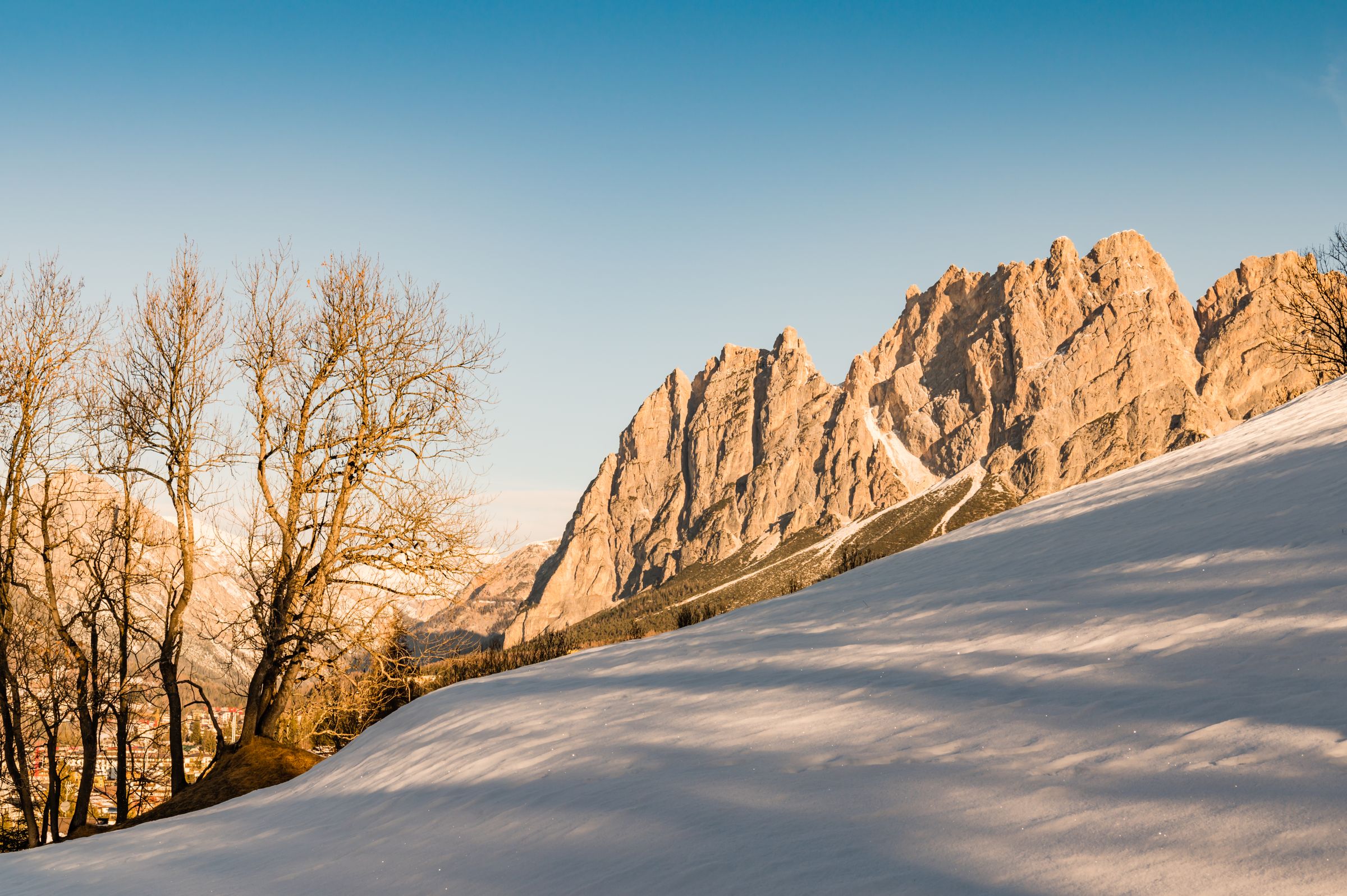
Where jagged limestone spires turn rose-gold at dusk and a century of Alpine grand-hotel tradition is being entirely rebuilt for the Olympic spotlight.
Plan this trip →- Suggested stay
- from 3 · 5 ideal · up to 9 nights
- Currency
- EUR
- Language
- Italian, Ladin, German, English
- Best season
- Two distinct high seasons. Winter (late December through March) for skiing the Dolomiti Superski circuit and the Sella Ronda, with the most reliable snow and coldest, clearest light from January to early March; Christmas/New Year and the Olympic-legacy winter of 2026-27 will be the most in-demand weeks. Summer (mid-June through September) for hiking, via ferrata and the enrosadira alpenglow, with July and August the warmest and busiest; September offers clearer air, thinner crowds and the same trail access. Shoulder seasons (April-May, October-November) see many hotels and cable cars close entirely.
Cortina d’Ampezzo is the Dolomites distilled into a single valley: a genteel Alpine resort town ringed by vertical walls of pale limestone that turn rose-gold at dawn and dusk, a phenomenon locals call the enrosadira. It has none of the glacier-and-granite grandeur of Zermatt or Chamonix. The Dolomites are younger looking and stranger, ancient coral reefs thrust skyward into spires, towers and sheer faces that seem almost architectural against the sky. Cortina itself, sometimes called the Queen of the Dolomites, has played reluctant host to the international set since the 1930s, and its Corso Italia pedestrian boulevard, lined with Fendi, Dior and Bogner storefronts against a backdrop of the Tofane massif, has quietly rivaled the shopping streets of resorts five times its size for nearly a century.
The region’s hotel landscape is in the middle of the most significant transformation it has seen in decades, timed deliberately to the Milano-Cortina 2026 Winter Olympics, which made Cortina the mountain-sports hub of a Games co-hosted with Milan for the first time in Olympic history. Aman completed a ground-up rebuild of the storied Rosa Alpina in San Cassiano, reopening in July 2025 as a full Aman property under Jean-Michel Gathy’s design. Mandarin Oriental is rebuilding the historic Grand Hotel Cristallo under architects Herzog & de Meuron, timed to open in Cortina itself for winter 2026-27. Between them, Forestis and COMO Alpina Dolomites, both opened in the years just before this wave, have already established the region’s benchmark for architectural restraint married to genuine wellness infrastructure, each carrying a Michelin Key.
What distinguishes this corner of the Alps gastronomically is how deeply its fine dining is rooted in the mountain itself. Riccardo Gaspari built SanBrite around his own family’s alpine farm above Cortina, taking it to a Michelin star and a Green Star for regenerative, zero-waste cooking. Matteo Metullio, one of Italy’s youngest Michelin-starred chefs, holds two stars at La Siriola inside the family-run Ciasa Salares in San Cassiano. Norbert Niederkofler, who built Rosa Alpina’s St. Hubertus into a three-star institution over two decades, has now moved his flagship south to Atelier Moessmer in Brunico, itself already carrying three stars and a Green Star, a reminder that this valley’s culinary talent radiates well beyond Cortina’s town limits.
Geographically, the ultra-luxury properties worth considering span three separate but connected valleys: Cortina itself and the Ampezzo valley, Alta Badia around San Cassiano and Corvara roughly forty minutes northwest, and the Val Gardena/Alpe di Siusi area a further hour beyond that. They are linked by the Dolomiti Superski lift network in winter and by mountain roads year-round, and a stay that touches more than one valley rewards travelers willing to move rather than plant a single base. Access remains the region’s one real friction point: there is no major international airport within the Dolomites themselves, and the closest gateways, Venice, Innsbruck, Verona and the general-aviation field at Bolzano, all require a transfer of ninety minutes to two and a half hours by road, or roughly thirty-five to forty-five minutes by helicopter from Venice.
Ideal for
Skiers and off-piste enthusiasts seeking the Sella Ronda and Alta Badia circuit · Design and architecture travelers drawn to Forestis, the incoming Mandarin Oriental, and Aman's rebuild · Serious food travelers chasing the region's dense cluster of Michelin stars and Green Stars · Summer hikers and via ferrata climbers · Winter Olympics history and sport enthusiasts, given Cortina's dual 1956/2026 Games legacy
Where to stay
The Houses
Aman Rosa Alpina
Aman · Ultra-premier alpine resort · San Cassiano, Alta Badia (approx. 35-40 minutes from Cortina)
The historic Rosa Alpina, run for three generations by the Pizzinini family and long one of the Dolomites' most storied addresses, closed in 2023 for a complete rebuild under architect Jean-Michel Gathy and reopened as a fully-owned Aman property in July 2025. The 51-key retreat retains the original building's Ladin bones while introducing Aman's signature spatial calm, two new 150-square-metre Aman Suites, and a private two-suite mountain residence in the reconfigured Chalet Zeno.
Why Rosa Alpina was already one of the most recognized names in Alpine hospitality before Aman's involvement, and the rebuild raises its physical standard to match Aman's global benchmark while retaining direct access to the same Alta Badia terrain that made the original famous.
Forestis Dolomites
Architectural wellness retreat · Plancios, above Bressanone/Brixen (approx. 75-90 minutes from Cortina)
Opened in 2020 on a former Habsburg-era mountain lodge site at 1,800 metres on the Plose, Forestis pairs stark, minimalist architecture with dense forest and near-360-degree Dolomites views. Its 62 suites, ranging from 50 to 200 square metres, are built around floor-to-ceiling glazing, and the property holds Two Michelin Keys.
Why Forestis is the clearest architectural counterpoint in the region to the more traditional chalet aesthetic, an exercise in restraint that has made it one of the most photographed hotels in the Alps since opening, and its Michelin Key recognition is among the most decorated in South Tyrol.
COMO Alpina Dolomites
COMO Hotels and Resorts · Alpine wellness resort · Alpe di Siusi (Seiser Alm), approx. 65-80 minutes from Cortina
COMO's first Alpine property sits on the edge of the Alpe di Siusi, Europe's largest high-altitude plateau, inside the UNESCO-listed Dolomites. The hotel holds a Michelin Key and combines COMO's signature Shambhala wellness philosophy with South Tyrolean mountain design.
Why COMO Alpina Dolomites brings the group's exacting wellness standard, refined over decades in Bali and the Maldives, to a genuinely different Alpine landscape, the open plateau rather than a valley floor, giving it a sense of space unusual for the region.
Mandarin Oriental Cristallo, Cortina
Mandarin Oriental · Historic grand hotel (pre-opening) · Cortina d'Ampezzo (in town)
The 1901 Grand Hotel Cristallo, long Cortina's most storied address and formerly operated by Marriott's Luxury Collection, closed in 2023 for a ground-up renovation and extension by architects Herzog & de Meuron. Mandarin Oriental has signed a long-term management agreement to relaunch it as the group's first Alpine resort, with 83 rooms including 30 suites and a 1,600-square-metre spa. NOT YET OPEN as of this writing; targeted for winter 2026, after the Milano-Cortina Olympics.
Why When it opens, this will be the first globally benchmarked ultra-luxury flag located inside Cortina itself rather than in an adjacent valley, occupying the town's most historically significant hotel site.
Ciasa Salares
Independent (Wieser family) · Family-run luxury chalet hotel · San Cassiano, Alta Badia
A three-generation, family-owned property best known for housing La Siriola, chef Matteo Metullio's two-Michelin-star restaurant, alongside a dedicated cheese room, chocolate room and wine bar. The hotel itself is intimate and traditionally Ladin in style, ski-in/ski-out to the Alta Badia lift network.
Why Ciasa Salares earns its place primarily through its kitchen; La Siriola is one of only two two-star restaurants in the immediate Cortina/Alta Badia orbit, and the hotel wraps it in a genuinely warm, family-run Alpine stay rather than a corporate one.
Hotel de Len
Boutique design hotel · Cortina d'Ampezzo (town centre)
A ground-up reinvention of the historic Hotel Impero in the heart of Cortina, Hotel de Len opened as a 22-room, 4-star boutique property with a rooftop spa looking directly over the valley and the town's Olympic ski facilities.
Why It is the most convincing true-luxury address located directly inside Cortina town rather than in an outlying valley, useful for travelers who want to walk to dinner and Corso Italia rather than base themselves thirty-plus minutes away.
Where to dine
The Tables
La Siriola
2 Michelin starsModern Italian / Alpine · fine dining
Chef Matteo Metullio, one of Italy's youngest Michelin-starred chefs, runs the signature restaurant of Ciasa Salares in San Cassiano with a menu that balances Alta Badia's Ladin traditions against internationally trained technique.
SanBrite
1 Michelin starRegenerative Alpine / farm-to-table · farmhouse fine dining
Owner-chef Riccardo Gaspari, a Cortina native and former cheesemaker, cooks almost entirely from his own family's alpine farm, El Brite de Larieto, making SanBrite the clearest expression of Dolomites terroir in the region and one of Italy's few restaurants to hold both a star and a Green Star.
Tivoli
1 Michelin starContemporary Italian / seafood and mountain · fine dining
Chef Graziano Prest has held his star for two decades at this Alpine house just outside central Cortina, pairing daily fish deliveries from the Venice and Chioggia markets with mountain ingredients and a serious wine cellar.
Atelier Moessmer Norbert Niederkofler
3 Michelin starsSustainable haute cuisine · fine dining
Norbert Niederkofler, the chef who built Rosa Alpina's St. Hubertus into a three-star destination over two decades, relaunched his flagship in a former textile villa in nearby Brunico and rebuilt it to three stars within months. It is now the region's most ambitious kitchen and worth the drive down-valley from Cortina or Alta Badia.
The Grill at Aman Rosa Alpina
Wood-fired Italian · hotel signature restaurant
The centerpiece of Aman Rosa Alpina's rebuilt dining program, focused on live-fire Italian classics; part of a wholesale reinvention of the property's food and beverage offer following St. Hubertus's departure.
Akari
Japanese (hot pot) · seasonal hotel restaurant
Aman Rosa Alpina's winter-only Japanese hot-pot concept, part of the same post-renovation dining relaunch, offering a lighter, more intimate counterpoint to The Grill.
Trattoria Dell'Alpe
Venetian and Veronese · hotel restaurant
COMO Alpina Dolomites' seafood-and-pasta room draws on Venice and Verona's culinary traditions, a deliberate contrast to the surrounding South Tyrolean farmhouse cooking and the more casual Alpina Chalet Grill and Bar elsewhere on the property.
What to do
Experiences
Via ferrata ascent with an IFMGA alpine guide
privateMountain adventure
A private IFMGA/UIAGM-certified guide leads a route matched to ability, from the WWI tunnels of Lagazuoi's Cesco Tomaselli to the exposed ledges and summit arena of the Giovanni Lipella route on Tofana di Rozes.
Why The Dolomites' via ferrata network is the range's signature experience, and its limestone exposure is unlike anything in the Swiss or French Alps. A private guide is the only way to do it safely and at a pace suited to the group.
Cinque Torri open-air WWI museum by helicopter or jeep
privateHistory and scenery
The five limestone towers above Cortina hold preserved Austro-Italian trench lines from 1915 to 1917. A private guide or helicopter transfer to the Rifugio Scoiattoli area sets up a walking tour of the fortifications with the Tofane massif as backdrop.
Why One of the most visually dramatic and historically dense sites in the entire Alpine arc, best appreciated with a guide who can narrate the front line rather than as a self-guided chairlift stop.
Heli-skiing and off-piste touring in Alta Badia and the Sella Ronda
by appointmentSkiing
Private ski guides arrange heli-drops and backcountry descents around the Sella massif and Fanes-Senes-Braies nature park, well outside the groomed Dolomiti Superski circuit.
Why The Dolomites' jagged, sheer-walled topography produces off-piste terrain with a totally different character from the rounded Swiss 4000ers, and the Sella Ronda lift network gives a private guide extraordinary reach in a single day.
Private tasting at an Alta Badia mountain agriturismo
by appointmentCulinary
Small, family-run mountain farms above San Cassiano and Corvara, several supplying Michelin kitchens directly, open for private cheese, speck and honey tastings arranged through the hotel concierge.
Why Ladin mountain food culture is the foundation of the region's celebrated fine dining scene (SanBrite's own farm is a prime example), and a private visit gives context no restaurant meal alone provides.
Sunrise or sunset enrosadira viewing at the Cinque Torri or Tre Cime di Lavaredo
privateScenery
A guided early-morning or evening excursion timed to the enrosadira, the pink-to-red alpenglow that gives Dolomite rock its name, at one of the range's iconic viewpoints.
Why This is the single most photographed natural phenomenon in the Dolomites and the clearest visual argument for why the range is considered distinct from the granite Alps further west.
Milano-Cortina 2026 Olympic venue tour
limited availabilitySport and heritage
Cortina hosted women's alpine skiing, curling, bobsleigh, skeleton and luge at the February 2026 Winter Games, reusing and rebuilding venues from the town's 1956 Olympics. Private tours of the sliding centre and Olympic Curling Stadium can be arranged post-Games.
Why Cortina is one of the only towns in the world to have hosted the Winter Olympics twice, 70 years apart, and the legacy venues are now a live part of the town's identity.
Shopping
The Maisons
Corso Italia
Cortina's pedestrianized main boulevard has been the Italian Alps' fashion showcase since the 1956 Winter Olympics. Flagship and seasonal boutiques from major maisons line a compact, walkable stretch through the town centre, interspersed with fine jewelers and the region's top ski-fashion houses.
By appointment
Several Corso Italia maisons run invitation or by-appointment private shopping during peak winter weeks (Christmas/New Year and the Olympic season)
Arrival & departure
Coming & Going
Airports
The primary international gateway, roughly 150 km / 2 to 2.5 hours by road, or approximately 35-45 minutes by helicopter directly to Cortina's heliport. Has a general aviation / private terminal handling facility.
Secondary option closer to Venice, mainly served by low-cost carriers; road transfer time to Cortina is comparable to VCE.
Approximately 160 km / 2 hours 15 minutes by road; a useful alternative gateway from Austria/Germany, with limited scheduled and charter service.
A general-aviation-only field roughly 130 km / under 2 hours from Cortina by road; used almost exclusively for private jet arrivals, with handling, fueling and lounge services geared to charter traffic.
A further scheduled-service alternative, roughly 2.5 to 3 hours by road, sometimes used for connecting flights from further afield.
Private terminals
- Venice Marco Polo has a dedicated general aviation apron and handling agents serving private jet arrivals
- Bolzano Airport (BZO) functions essentially as South Tyrol's private aviation gateway, with no meaningful scheduled commercial service
Meet & greet · gate escort
- Fast-track and meet-and-greet services are available through private handling agents at Venice Marco Polo for charter and business aviation arrivals
First-class & arrivals lounges
- Private aviation lounges at Bolzano and Venice's general aviation terminal, accessed through charter handling agents rather than airline status
Private transfers
- Private car transfer, Venice Marco Polo to Cortina: approximately 2 to 2.5 hours
- Private car transfer, Innsbruck to Cortina: approximately 2 hours 15 minutes
- Private car transfer, Bolzano to Cortina: approximately 2 hours
- Cortina Express and other premium coach transfer services operate from Venice Marco Polo, roughly 2.5 hours
Private aviation
- Direct helicopter transfer from Venice Marco Polo to Cortina's heliport, approximately 35-45 minutes, offered by regional operators such as Venicejets, Elicompany and Hoverfly
- Private jet charter to Bolzano Airport (BZO), the region's dedicated general aviation field, from major European hubs
- Charter operators including GlobeAir, AeroAffaires and PrivateJet.com serve Cortina/the Dolomites as a named destination
Good to know
Questions & Answers
When is the best time to visit Cortina & the Dolomites? +
Two distinct high seasons. Winter (late December through March) for skiing the Dolomiti Superski circuit and the Sella Ronda, with the most reliable snow and coldest, clearest light from January to early March; Christmas/New Year and the Olympic-legacy winter of 2026-27 will be the most in-demand weeks. Summer (mid-June through September) for hiking, via ferrata and the enrosadira alpenglow, with July and August the warmest and busiest; September offers clearer air, thinner crowds and the same trail access. Shoulder seasons (April-May, October-November) see many hotels and cable cars close entirely.
How many nights should you spend in Cortina & the Dolomites? +
5 nights is the sweet spot; 3 at a minimum, and up to 9 if you want to take it slowly.
What are the best luxury hotels in Cortina & the Dolomites? +
The Grand Index ranks 6 houses in Cortina & the Dolomites. The ultra-premier tier: Aman Rosa Alpina, Forestis Dolomites, COMO Alpina Dolomites, Mandarin Oriental Cristallo, Cortina. Each is bookable through our advisor at the same rate as direct, with VIP perks layered on.
Which airport do you fly into for Cortina & the Dolomites? +
Venice Marco Polo Airport (VCE); Treviso Airport (TSF); Innsbruck Airport (INN); Bolzano Airport (BZO); Verona Villafranca Airport (VRN).
Can I book Cortina & the Dolomites hotels through The Grand Index? +
Yes. Our advisor books every house featured here through Fora, a Virtuoso member agency, at the same rate you would pay direct — with VIP perks such as room upgrades, daily breakfast and a property credit layered on at no extra cost. Begin at the enquiry page.
Where to next
You might also like
The Alps
Courchevel 1850
France
The grande dame of alpine luxury, where the world's finest hotels and tables gather above the tree line.
The Alps
Gstaad
Switzerland
The Bernese Oberland's discreet billionaire village, where chalet wood outranks marble.
The Alps
St. Moritz
Switzerland
The Alpine resort that invented winter tourism — and still sets its terms.