Mediterranean · Italy
Tuscany
Nine hundred years of estate life across Val d'Orcia and Chianti, where the castle you sleep in also makes the wine you drink.
Plan this trip →- Suggested stay
- from 3 · 5 ideal · up to 8 nights
- Best season
- Late April to June and September to mid-October deliver warm days, the grape and olive harvests, and truffle season, while avoiding the August heat and crowds. Several estate hotels close December through mid-March, so winter travel narrows the choice sharply.
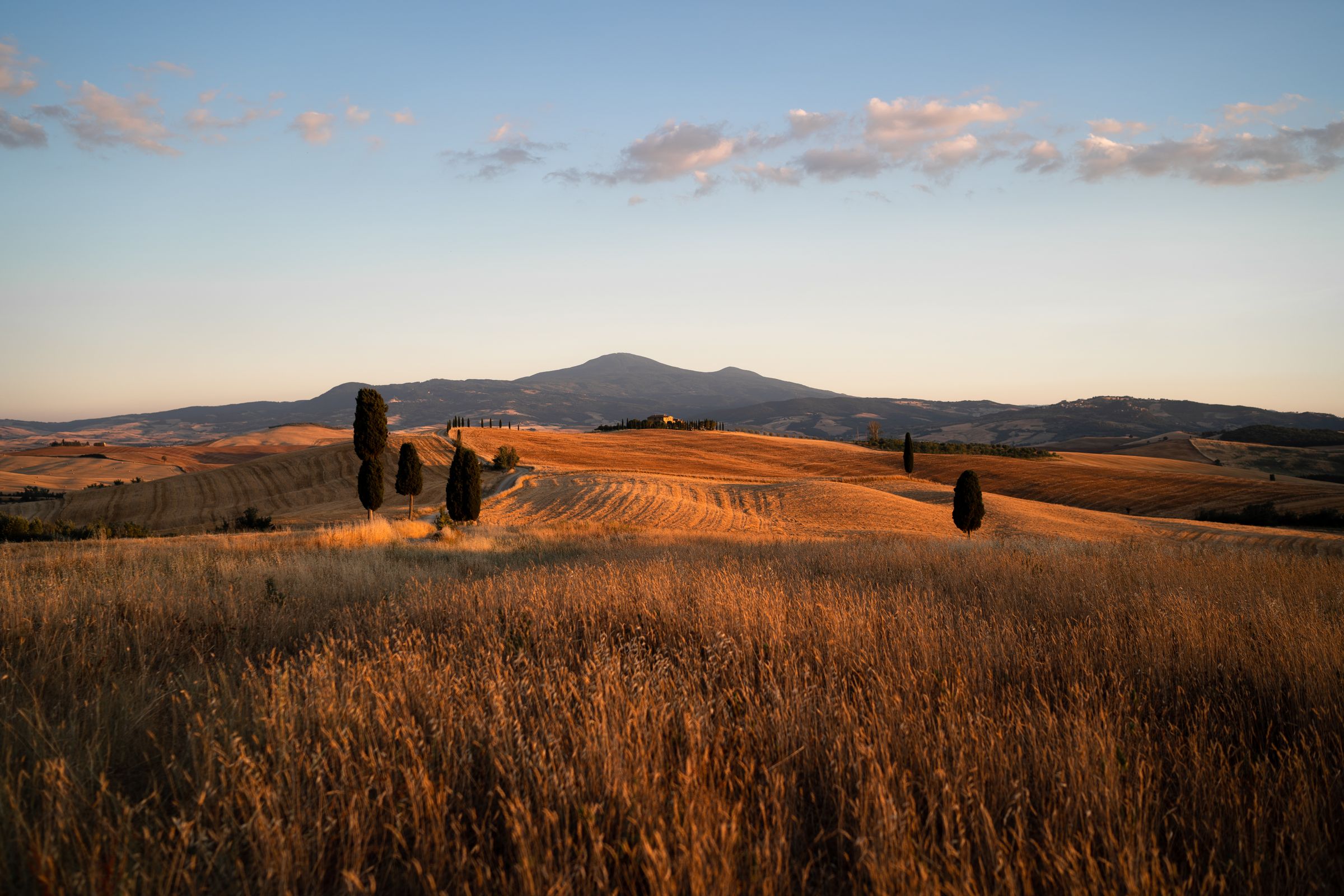
Tuscany’s countryside is not one place but three overlapping worlds, and the distinction matters at this altitude of travel. Val d’Orcia, south of Siena, is the UNESCO-listed landscape of cypress rows and Brunello vineyards. Chianti, between Florence and Siena, is the older, denser wine country of stone villages and abbey cellars. Maremma, to the southwest, runs wilder and less trodden toward the coast. What binds them is a particular kind of hotel: the working estate, where the castle you sleep in also presses the olive oil and ages the wine.
The finest of these are less hotels than restored fiefdoms. Rosewood Castiglion del Bosco spreads across two thousand hectares of Val d’Orcia with its own Brunello label and a kitchen, Campo del Drago, that took a second Michelin star in the 2025 guide. Castello di Reschio, a thousand-year-old castle reimagined over three decades by a single family, opened in 2021 as one of Europe’s most closely watched debuts. Borgo Santo Pietro runs a genuine three-hundred-acre organic farm behind its Michelin-starred, Green-Starred table. Each is self-sufficient enough that a guest need never leave the gates.
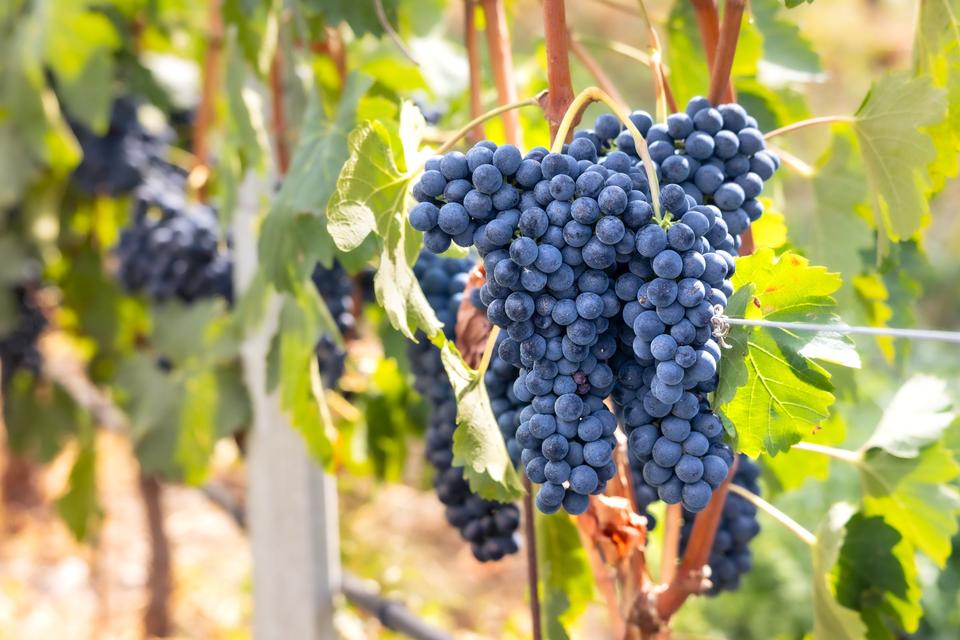
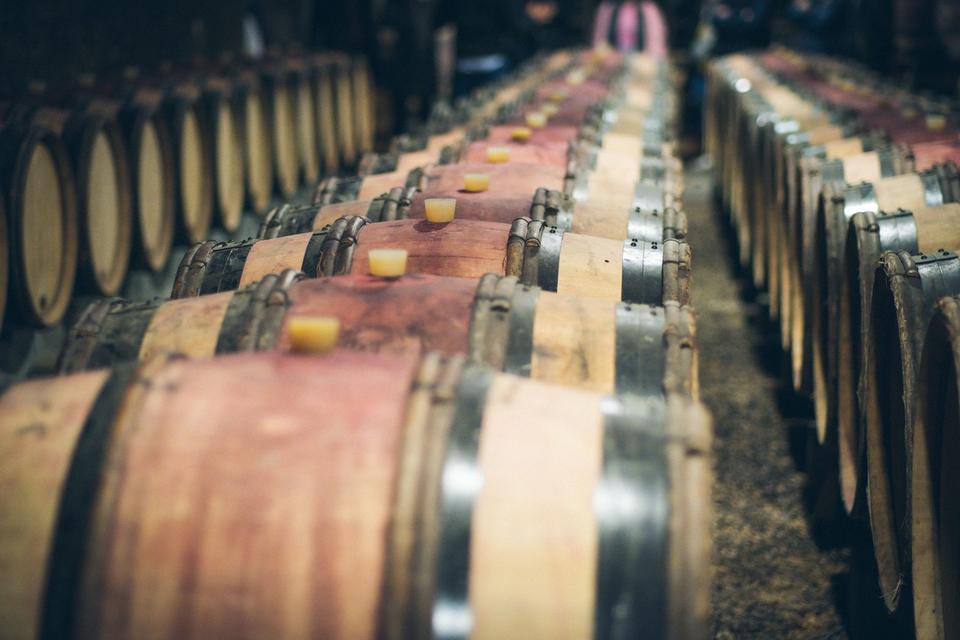
The gastronomy here is inseparable from the land. Antinori’s landmark Bargino winery, ranked the world’s best vineyard in 2022, sits buried in a Chianti hillside; its Osteria di Passignano has held a star since 2007. Brunello di Montalcino, Vino Nobile, and Chianti Classico are tasted at the source, in cellars that open their doors only by private arrangement. In autumn the trifolau and his dogs turn the estate woods into a larder of white and black truffles.
The rhythm rewards patience. Five nights is the natural span: a base in Chianti for the wine and the abbeys, a base in Val d’Orcia for the Renaissance towns and the light, and days that rarely begin before a late breakfast in the garden. This is countryside built for slowness, and the estates are engineered to encourage it.
Arrival is best kept quiet. Mid-size jets reach Florence’s Peretola, larger aircraft land at Pisa, and a helicopter can compress the whole region into a single afternoon. From the pad it is a short drop to a gravel drive, a cellar, and a table laid with what the estate grew that morning.
Ideal for
Wine collectors and gastronomes · Couples and honeymooners · Multigenerational villa takeovers · Design and architecture enthusiasts
In view
The Setting
Where to stay
The Houses
Rosewood Castiglion del Bosco
Rosewood Hotels & Resorts · Estate resort · Montalcino, Val d'Orcia (UNESCO World Heritage Site)
A 2,000-hectare, roughly 900-year-old estate inside the UNESCO-listed Val d'Orcia, owned by the Ferragamo family and operated by Rosewood. Accommodation spans suites in the restored borgo and a portfolio of private villas, alongside a working Brunello winery, a Tom Weiskopf golf course, and a Sense spa. The resort reopened for the season on 21 March 2025 and holds Forbes Five-Star recognition.
Why The most complete estate in the region: its own Brunello di Montalcino, a two-Michelin-star restaurant, and villa privacy on a scale nothing else in Val d'Orcia matches.
Dining: Ristorante Campo del Drago, 2 Michelin stars
Castello di Reschio
Independent (Bolza family) · Castle estate hotel · Lisciano Niccone, on the Umbria-Tuscany border
A thousand-year-old castle at the heart of a 1,500-hectare estate, restored over three decades by the Bolza family and opened as a 36-suite hotel in 2021. Count Benedikt Bolza designed the interiors and much of the furniture himself, giving the property a singular, lived-in aesthetic. Dining is at Ristorante Al Castello in the western ramparts, with the glass-roofed Palm Court bar alongside.
Why One of Europe's most talked-about estate openings of the decade, and an unmatched expression of a single family's design vision. Note it sits just over the border in Umbria.
Borgo Santo Pietro
Villa estate hotel · Chiusdino, near Siena
A restored 12th-century villa on a 300-acre organic farm with vineyards, a cooking school, and thirteen acres of gardens, about 45 minutes from Siena. The property holds Three Michelin Keys and its restaurant, Saporium (formerly Meo Modo), carries a Michelin star and a Green Star for sustainability. Farm-to-plate is not a slogan here; the estate grows and raises most of what it serves.
Why The region's benchmark for a self-contained farm estate, with genuine agricultural depth behind the luxury and a rare Michelin star plus Green Star pairing.
Dining: Saporium, 1 Michelin star (and Michelin Green Star)
COMO Castello del Nero
COMO Hotels and Resorts · Castle estate hotel · Tavarnelle Val di Pesa, Chianti Classico
A 12th-century castle on a 740-acre Chianti estate midway between Florence and Siena, operated by COMO with the group's signature COMO Shambhala spa and wellness program. The flagship restaurant, La Torre, has held a Michelin star for more than a decade and sits in the castle's former stables. The property holds a Michelin Key.
Why The strongest Chianti Classico base, pairing a long-starred kitchen with COMO's wellness rigor and easy reach of both Florence and Siena.
Dining: La Torre, 1 Michelin star
Castello di Casole, A Belmond Hotel
Belmond (LVMH) · Estate resort · Casole d'Elsa, near Siena
A restored castle on a 4,200-acre estate in the hills near Siena, operated by Belmond with 39 suites and a portfolio of private estate villas. The property runs seasonally, roughly mid-March through October, and has added tennis, a bike hub, and expanded wellness programming. Its scale gives it some of the most private and expansive grounds of any estate hotel in the region.
Why Vast, deeply private acreage under the Belmond banner, and one of the few estates here that connects to the Venice Simplon-Orient-Express for a rail arrival.
Where to dine
The Tables
Ristorante Campo del Drago
2 Michelin starsContemporary Tuscan · fine dining
Chef Matteo Temperini's cooking earned a second star in the 2025 guide, drawing on the estate's own gardens and Brunello cellar.
Saporium
1 Michelin starFarm-to-plate Tuscan · fine dining
At Borgo Santo Pietro, the near-entirety of the menu comes from the estate's own farm, a genuine expression of the Green Star ethos.
La Torre
1 Michelin starContemporary Italian · fine dining
Set in COMO Castello del Nero's former stables, with three menus built around estate produce, local meats, and seafood.
Osteria di Passignano
1 Michelin starChianti Classico · estate osteria
Antinori's restaurant beside the Badia di Passignano abbey, above cellars where the family's Chianti Classico ages, with a benchmark wine list.
Rinuccio 1180
Traditional Tuscan · winery restaurant
Traditional Tuscan cooking on the roof of Antinori's landmark Bargino cellar, with sweeping Chianti views and the estate's wines by the glass.
Ristorante Al Castello
Estate-driven Italian · castle dining
Castello di Reschio's candlelit dining room draws almost entirely on the estate's organic gardens; the private Family Table is the room to request.
What to do
Experiences
Private Brunello di Montalcino tasting
By appointmentWine
A privately guided circuit of Montalcino's most sought-after Brunello producers, with cellar visits, vineyard walks, and vertical tastings, often paired with a winemaker lunch.
Why Brunello is Tuscany's most prestigious red, and the top estates open their cellars only to private, pre-arranged visits.
Truffle hunting with a trifolau
By appointmentCulinary
A morning in the estate woods with a licensed truffle hunter and his dogs, followed by a truffle-forward lunch or tasting menu. Several of the anchor estates, including COMO Castello del Nero, run their own on-property hunts.
Why A truly seasonal, low-volume experience that turns the estate's own land into the day's larder.
Antinori nel Chianti Classico cellar tour
By appointmentWine
A private tour of the buried, architecturally celebrated Bargino winery, ranging from the three-wine Tinaia tour to the seven-wine Cru immersion, closing with lunch at Rinuccio 1180.
Why Ranked the World's Best Vineyard in 2022, it is the single most impressive winery visit in Chianti.
Val d'Orcia and Renaissance towns by car or helicopter
PrivateCultural
A privately driven or helicopter-reached day across Pienza, Montepulciano, Montalcino, and the Abbey of Sant'Antimo, threading the UNESCO landscape of cypress-lined roads.
Why The Val d'Orcia is a UNESCO World Heritage cultural landscape, and a helicopter compresses a full region into an afternoon.
Estate cooking school and market classes
By appointmentCulinary
Hands-on classes at estate cooking schools such as Borgo Santo Pietro's, working with produce harvested that morning from the property's own gardens and farm.
Why The farm-to-table estates teach with ingredients they grow, a depth of provenance rare even in Italy.
Riding and country pursuits at Reschio
By appointmentAdventure
Horseback riding on the estate's own horses across 1,500 hectares of hills and oak woodland, plus spa and garden walks, at Castello di Reschio.
Why Reschio's stables and vast private land make it the region's finest base for riding through the countryside.
Shopping
The Maisons
Montalcino and Montepulciano wine towns
Hilltop towns whose streets are lined with enoteche and producer shops selling Brunello, Vino Nobile, and estate olive oils direct from the source.
Greve in Chianti and Panzano
The heart of Chianti Classico artisan commerce, anchored by celebrated butchers, wine merchants, and ceramics.
By appointment
Private winery allocations and en primeur reservations · Estate olive oil and honey direct from the anchor properties
Arrival & departure
Coming & Going
Airports
Tuscany's primary gateway, closest to Chianti at roughly 30 to 60 minutes. Short single runway limits it to smaller and mid-size private aircraft.
The region's largest airport, handling long-range and larger aircraft; about 80 km west of Florence, roughly 1.5 to 2 hours from the estate belt.
Long-haul intercontinental gateway; roughly 2.5 to 3 hours by car to Val d'Orcia, often paired with a helicopter transfer.
Private terminals
- Private/general aviation handling at Florence (FLR)
- FBO and business-aviation handling at Pisa (PSA)
Meet & greet · gate escort
- Estate concierges arrange airport meet-and-greet and fast-track
- Private drivers coordinated by each property
First-class & arrivals lounges
- Airline and general-aviation lounges at FLR and PSA
Private transfers
- Chauffeured car transfers arranged by each estate
- Helicopter transfers to estate helipads and nearby fields (approx. 15 min to Chianti, 40 min to Val d'Orcia)
Private aviation
- Mid-size and light jets into Florence (FLR)
- Larger and long-range jets into Pisa (PSA)
- Helicopter positioning to estates from FLR, PSA, and Rome
Good to know
Questions & Answers
When is the best time to visit Tuscany? +
Late April to June and September to mid-October deliver warm days, the grape and olive harvests, and truffle season, while avoiding the August heat and crowds. Several estate hotels close December through mid-March, so winter travel narrows the choice sharply.
How many nights should you spend in Tuscany? +
5 nights is the sweet spot; 3 at a minimum, and up to 8 if you want to take it slowly.
What are the best luxury hotels in Tuscany? +
The Grand Index ranks 5 houses in Tuscany. The ultra-premier tier: Rosewood Castiglion del Bosco, Castello di Reschio, Borgo Santo Pietro, COMO Castello del Nero. Each is bookable through our advisor at the same rate as direct, with VIP perks layered on.
Which airport do you fly into for Tuscany? +
Florence Amerigo Vespucci (Peretola) (FLR); Pisa Galileo Galilei (PSA); Rome Fiumicino (FCO).
Can I book Tuscany hotels through The Grand Index? +
Yes. Our advisor books every house featured here through Fora, a Virtuoso member agency, at the same rate you would pay direct — with VIP perks such as room upgrades, daily breakfast and a property credit layered on at no extra cost. Begin at the enquiry page.
Where to next
You might also like
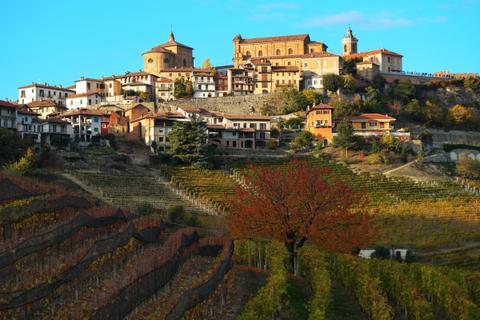
Mediterranean
Piedmont
Italy
Italy's densest constellation of Michelin stars, cradled in the Barolo hills where the white truffle is dug by lamplight.
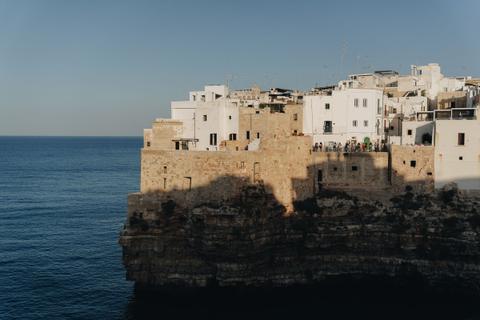
Mediterranean
Puglia
Italy
Italy's sun-bleached heel, where cucina povera wears Michelin stars and ancient masserie become private worlds.
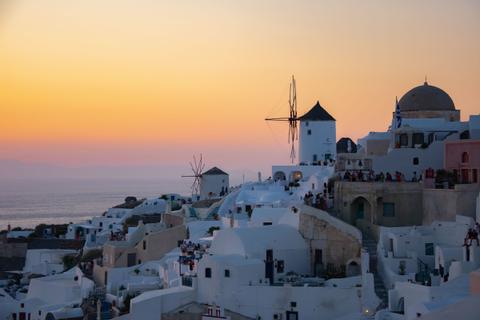
Mediterranean
Santorini
Greece
A drowned volcano crowned in white, where the caldera falls away into the Aegean at the world's most theatrical sunset.